
At first glance, 1967 Washington quarters look unremarkable. No silver. No mintmarks on most coins. Massive production numbers. For many collectors, that combination signals low value. The reality is more nuanced. While 1967 offers no classic key dates, it sits at a critical moment in U.S. coinage history, and that alone keeps interest alive.
This was the heart of the post-silver transition era. After removing silver from dimes and quarters in 1965, the U.S. Mint focused on stabilizing circulation. Speed and volume mattered more than collectibility. As a result, the 1967 quarter no mint mark existed in huge quantities, but the production shortcuts of the time also opened the door to identifiable varieties and genuine mint errors.
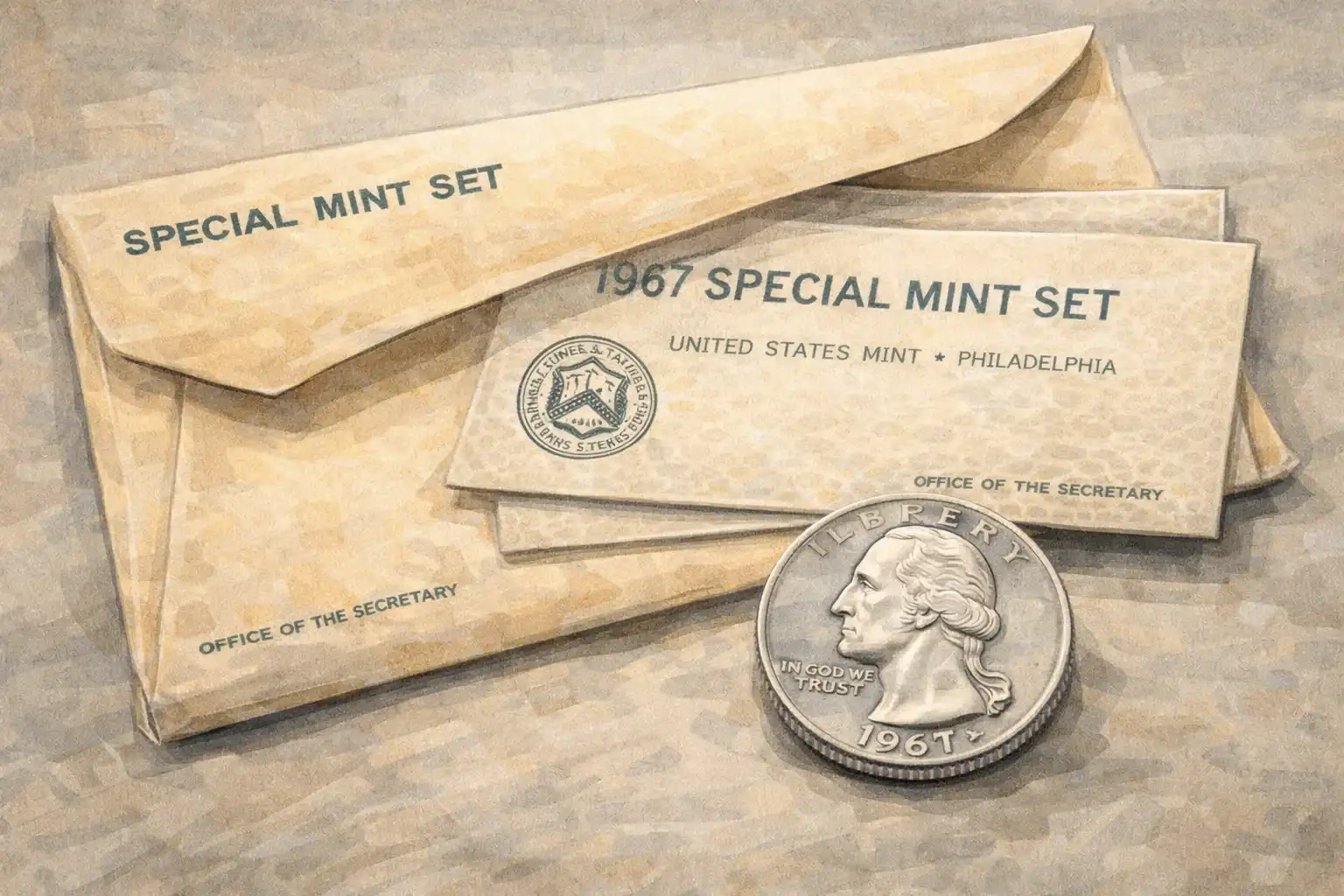
Mintage and Mint Structure in 1967
In 1967, the Mint suspended traditional mintmarks to discourage hoarding. Most quarters show no mintmark, regardless of where they were struck. Philadelphia carried the bulk of production, with Denver contributing heavily as well.
Approximate output figures tell the story clearly:
- Philadelphia (no mintmark): over 1.5 billion coins
- Denver (no visible mintmark): comparable scale
- Special Mint Set (SMS): limited collector-focused production
With numbers like these, scarcity was never going to come from standard circulation strikes.
Standard Circulation Issues: Abundant and Affordable
For everyday collectors, standard 1967 quarters remain among the most accessible coins of the decade.
Typical market behavior:
- Circulated VF–XF: face value to about $2
- Uncirculated MS-63 to MS-65: $10–25 raw
- Higher mint state: condition rarity begins to matter
These coins work well as placeholders in 1960s clad sets or educational examples of post-silver coinage. They carry no intrinsic metal premium and rely entirely on condition. Use the coin identifier app to verify such findings and prove their affordability.
Special Mint Sets: The First Step Above Common
Between 1965 and 1967, the Mint replaced proof sets with Special Mint Sets. The 1967 SMS quarter stands out from circulation strikes through cleaner surfaces and occasional cameo contrast.
Collectors look for:
- Sharper details than business strikes
- Satiny or lightly mirrored fields
- Cameo contrast on higher-grade examples
Prices remain reasonable, but certified SMS coins in MS-67 and above can reach $50–150, depending on eye appeal. These pieces bridge the gap between common change and true rarities.
Why 1967 Still Deserves a Closer Look
The appeal of 1967 quarters does not come from classic rarity. It comes from selectivity. Most coins are common. A small percentage are not. That distinction defines the entire market for this year and sets the stage for varieties and errors that genuinely stand apart.
Rare Issue Varieties: Where 1967 Quarters Gain Real Value
With standard circulation coins ruled out as major value drivers, attention turns to varieties and mint errors. This is where 1967 quarters justify a second look. The market rewards pieces with clear diagnostics through the coin worth app, documented listings, and professional certification. Everything else blends back into face-value territory.
Doubled Die Varieties: Subtle but Legitimate
True doubled dies from 1967 are scarce, but they exist. The most cited example is the Doubled Die Obverse (DDO), FS-101.
Key identifying features include:
- Visible doubling on LIBERTY
- Secondary impressions on the date numerals
- Clean separation rather than flat, shelf-like edges
This matters because many coins show machine doubling, which adds no value. The FS-101 doubled die comes from hub doubling and is recognized by PCGS and NGC.
Market behavior for confirmed examples:
- AU to low MS: $100–200
- Uncirculated with strong detail: $300–450
Collectors usually find these through roll searching or old accumulations rather than dealer trays.
On the reverse side, doubled die reverse (DDR) examples show separation on the eagle’s feathers or lettering. These remain less famous but still desirable when properly attributed.
Strike Errors: Affordable Rarities with Visual Impact
Strike errors form the most approachable rare category for 1967 quarters. They are easy to see, harder to fake convincingly, and widely collected.
The most important types include:
Off-Center Strikes
Coins struck partially outside the collar show missing design areas.
- Value rises when the date remains visible
- 50% off-center examples often sell for $100–300 certified
Wrong Planchet Errors
Some 1967 quarters were struck on incorrect blanks.
- Nickel planchets (5.0 g instead of 5.67 g): $130–1,400
- Silver planchets: rare and highly prized, often exceeding $1,000
Weight verification is critical. These errors rely on precise measurements to confirm authenticity.
Separating Reality from Online Hype
The internet inflated expectations for 1967 quarters. Claims of “rare no-mintmark errors” or vague doubling appear frequently. Most are misattributions.
Reliable value requires:
- Clear diagnostics matching published references
- Third-party certification for liquidity
- Weight and diameter checks for planchet errors
Without those elements, premiums evaporate quickly.
1967 Quarter Varieties at a Glance
| Variety | Rarity Level | Value Range (Certified) |
| Standard clad VF | Common | $0.25–2 |
| SMS Cameo MS-67 | Semi-scarce | $50–150 |
| DDO FS-101 UNC | Scarce | $100–450 |
| Nickel planchet error | Rare | $130–1,400 |
| 50% off-center strike | Very rare | $100–300 |
The pattern stays consistent. 1967 quarters are not rare by default. Value emerges only when production mistakes or documented varieties break through the noise.
Affordable Options, Smart Buys, and How to Collect 1967 Quarters Wisely
The smartest way to approach 1967 Washington quarters is with restraint. This year offers a clear split between common coins and collectible outliers. Knowing where that line sits prevents overspending and keeps expectations realistic.

Affordable Paths for Collectors
Most collectors start with the accessible side of the market. Standard 1967 quarters fill album slots cleanly and cost very little.
Practical options include:
- Circulated examples for type sets or teaching collections
- Raw uncirculated coins from rolls or estate lots
- Special Mint Set (SMS) quarters with modest cameo contrast
SMS coins offer the best balance of quality and price. Certified pieces in MS-66 to MS-67 often cost less than modern proofs while still showing superior surfaces compared to circulation strikes.
How to Hunt for Varieties and Errors
Finding value in 1967 requires focus. Random searching rarely works. Targeted checks do.
A simple process:
- Scan LIBERTY and the date for true doubling
- Check coin weight and thickness to spot planchet anomalies
- Look for obvious strike misalignment or off-center designs
A 10× loupe and accurate scale do most of the work. Anything promising should be compared to verified references before purchase.
Using Digital Tools to Filter Candidates
Large mixed lots slow decision-making. Tools like the Coin ID Scanner app help streamline that first pass. Using a single photo on Android or iOS, the app returns a detailed coin card with year of minting, country, coin type, edge, composition, diameter, weight, and an indicative price range drawn from a database of over 187,000 coins.
This makes it easier to separate standard 1967 quarters from SMS strikes or potential error candidates before deeper inspection.
Once a collection grows, built-in collection management helps track acquisitions and avoid duplicates. Premium features such as smart filters and the AI Helper assist with comparisons and prioritization without replacing manual verification.
1967 produced no hidden key dates. That fact keeps prices grounded. At the same time, the year delivers approachable errors, interesting varieties, and clean SMS coins that remain affordable.
For collectors who balance patience with documentation, 1967 quarters reward selectivity rather than speculation. Most coins stay cheap. The right ones stand apart—and those are worth the effort.