
1977 Nickel value rarely stems from age alone.
Market potential depends exclusively on condition and detail sharpness.
The United States Mint produced a massive volume of five-cent coins featuring Thomas Jefferson in 1977.
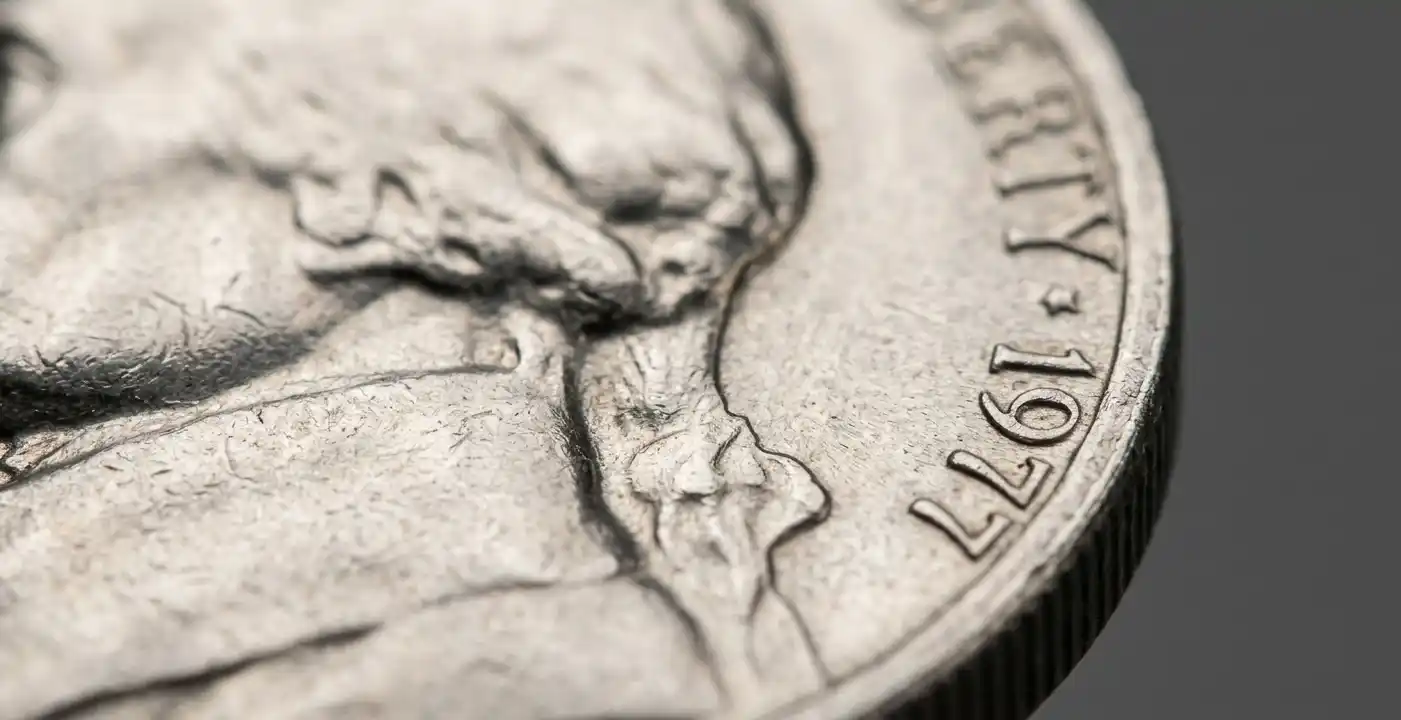
Most these specimens remain in circulation, possessing only face value.
Investment interest targets only coins retaining original mint luster and lacking mechanical damage.
| Parameter | Value |
| Composition | 75% Copper, 25% Nickel |
| Mass | 5 grams |
| Diameter | 21.21 mm |
| Edge Type | Plain |
| Designer | Felix Schlag |
Mintage Distribution Across Facilities
Total production exceeded nine hundred million pieces.
High availability causes low prices for common specimens.
Coins lacking a mint mark originated in Philadelphia.
The letter D signifies Denver production.
The letter S on Proof coins indicates the San Francisco facility.
- Philadelphia — 585,376,000 pieces
- Denver — 321,548,116 pieces
- San Francisco — 3,251,152 pieces
Grading Impact on Market Pricing
The Sheldon scale ranging from 1 to 70 points determines coin quality.
The MS66 grade serves as the critical threshold for the 1977 issue.
Specimens falling below this level carry a value of only a few dollars.
Reaching the MS67 grade triggers exponential price growth.
Limited availability of perfect preservation regarding mass-production technologies of the seventies explains this trend.
| Grade (MS) | Estimated Price (2026) | 5-Year Change |
| MS63 | $0.25 | 0% |
| MS64 | $1.00 | +5% |
| MS65 | $5.00 | +12% |
| MS66 | $25.00 | +18% |
| MS67 | $450.00 | +35% |
The Full Steps (FS) Factor
Evaluators prioritize the steps on the reverse side depicting the Monticello estate.
Clear separation of five or six steps receives the Full Steps designation.
This detail indicates a strong strike and careful handling.
Lacking Full Steps reduces value dozens of times even with a high overall grade.
Possessing FS → confirming high strike quality → automatically increasing market demand.
| Grade | Without FS | With FS Designation |
| MS65 | $4 | $15 |
| MS66 | $18 | $80 |
| MS67 | $150 | $2,500 |
Record Auction Sales
Analyzing data from professional certification services, such as the coin finder, highlights peak values.
Heritage Auctions sold a 1977-D specimen graded MS67+ FS for $5,170.
Absence of contact marks typical of bag storage justified this high price.
Philadelphia specimens in similar condition occur less frequently, reaching a $4,000 price point.
The Proof coin market demonstrates stable but lower indicators.
A 1977-S coin graded PR70 Deep Cameo trades between $150 and $200.
Minting Errors and Market Share
Striking errors create unique specimens standing outside standard catalogs.
Coins struck on planchets intended for other denominations remain the most valuable.
Offsetting the image by more than 25% also increases value.
- Double Strike — the image appears twice resulting from repeated die contact with the planchet.
- Struck on Cent Planchet — the coin acquires a copper color and smaller diameter.
- Die Clash — obverse elements appear faintly on the reverse.
Valuations for such errors range from $50 to $1,500.
Inflation and Demand Factors
Statistics show an annual price increase for rare positions at 4-7 percent.
Common coins lose value due to dollar inflation.
Investing remains justified only when purchasing coins with PCGS or NGC certificates.
Uncertified coins often harbor hidden defects discovered during professional inspection.
Cleaning a coin with chemicals completely destroys its collectible value.
Washed patina → losing mint luster → receiving a Details grade instead of a numeric value.
Authenticity and Defect Detection
The free coin app verification follows three primary directions.
| Inspection Object | Genuine Sign | Alteration Sign |
| Weight | Exactly 5 grams | Deviation exceeding 0.2 grams |
| Lettering | Sharp letter edges | Blurriness or metal swelling |
| Surface | Radial flow lines | Circular scratches from cleaning |
Relative Scarcity Compared to Adjacent Years
The 1977 issue appears more common than the 1971 or 1975 years.
However, a surge in “weak strike” steps occurs specifically in 1977.
This makes discovered Full Steps specimens more valuable relative to similar positions from other years.
Market dynamics over the last three years show rising interest in MS66+ grades.
Quantities of registered coins at this level in NGC registries do not exceed several hundred.
Deep Dive into Preservation Techniques
Collectors must avoid touching the coin surfaces with bare fingers.
Oils from skin cause permanent staining over time.
Storing coins in PVC-free holders prevents chemical damage.
Maintaining stable humidity stops metal oxidation.
The Role of Population Reports
Professional graders publish statistics on how many coins exist in each grade.
A “Pop 1” coin signifies the only known specimen at that quality level.
Competitive bidding often occurs when a collector seeks the highest known grade for a registry set.
The 1977 nickel has a surprisingly low population of MS68 specimens.